
My friend Dana texted me a screenshot from her phone at the gym, one of those “VIP peptide program” sites, cart already loaded, ready to check out. She wanted my read on it before she typed her card number in. Here’s the thing: I’m not a doctor, I want to say that up front, but I do know how to read a website with a skeptical eye, and I spent the next several days doing exactly that so I could give her (and now you) a straight answer instead of a shrug.
What I found wasn’t pretty. Almost every site calling itself a “VIP program” turned out to be a shopping cart wearing a costume. Click past the homepage and there’s no clinician, no pharmacy, just a “for research use only” disclaimer doing all the legal lifting so they can sell you a vial without anyone checking whether it’s a good idea. The word “program” implies structure, intake forms, a person who follows up with you. Most of what’s out there has none of that. A real program, the kind with an actual clinician and an actual licensed pharmacy standing behind it, was the exception. I only found two.
Let me be straight with you about how I sorted this out, because the ranking only makes sense once you understand what I was actually testing for.
VIP is a compounded medication, not an FDA-approved therapy, and the evidence for its everyday wellness use is limited. Talk to a licensed clinician before starting anything described here.
What I made myself learn before I judged anybody
I wasn’t about to rank “programs” for a peptide I hadn’t bothered to understand, so I did the reading first.
VIP is a 28-amino-acid neuropeptide your own body already produces, and in lab and animal research it’s a genuinely interesting anti-inflammatory signal, the kind that calms down messengers like TNF-alpha. The 2013 Delgado and Ganea review in Amino Acids covers that ground well (PMID 22139413). That part is solid biology. Where it gets shaky is the human evidence, and it gets shaky fast. The best signals we have are small and confined almost entirely to lung medicine: eight people with pulmonary hypertension in a 2003 Journal of Clinical Investigation study (PMID 12727925), twenty people with sarcoidosis in a 2010 trial in the American Journal of Respiratory and Critical Care Medicine where inhaled VIP was safe and calmed lung inflammation (PMID 20442436). Promising, but tiny and early, the kind of results that need a lot more testing before anyone builds a wellness routine on top of them.
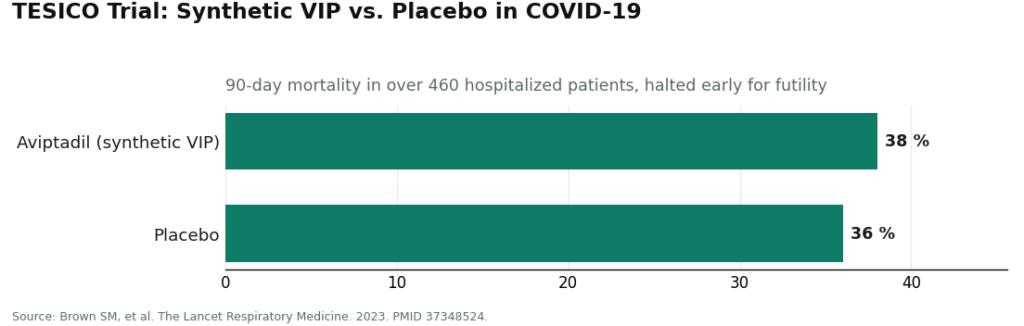
And then there’s the result that really settled it for me. The one time VIP got a big, properly run trial, the TESICO trial published in The Lancet Respiratory Medicine in 2023, over 460 COVID patients, synthetic VIP (aviptadil) simply did not help. The trial was stopped early for futility, with 90-day mortality landing at 38 percent in the treatment group versus 36 percent on placebo (PMID 37348524). A 2023 review in Life Sciences points to a likely reason these trials keep coming up short: VIP breaks down in the body almost as fast as you give it (PMID 37742737).
So by the time I went shopping for “programs,” I already knew the honest answer: nobody has proven VIP does much for everyday wellness in humans. That changed what I was even looking for. If the molecule itself is a question mark, the only thing worth paying a “program” for is honest handling of that uncertainty, someone qualified deciding whether it’s appropriate for you, a real pharmacy, and the truth stated plainly instead of buried.
The five questions I’d ask if Dana called me from the checkout page
I didn’t grade anybody on “does VIP work,” because nobody can answer that with confidence yet, and I wasn’t going to reward whoever wrote the most confident-sounding copy. Instead I ran every option through the questions I’d actually want answered before a friend hit buy:
- Is this a real program, or just a cart with a nice name? Intake, a clinician, follow-up, or just a “program” label slapped on a buy button?
- Who’s minding the store, clinically? Is a licensed clinician actually deciding whether VIP makes sense for this person, at what dose, with any follow-up at all?
- Where’s it coming from? A licensed US compounding pharmacy (503A or 503B), or an unmarked vial shipped as “research material”?
- Has anyone besides the seller checked it? Independent identity, purity, and sterility testing, with a certificate you can actually see, not just a seller’s word.
- Do they tell you the truth? Do they say plainly that VIP isn’t FDA-approved and the evidence is thin, or do they let you assume it’s proven?
How it sorted out
Once I ran everything through those five questions, the field split cleanly into two groups, and the gap between them wasn’t subtle at all.
Group one, actual programs. Two providers had a clinician in the loop, a licensed pharmacy behind them, and honesty about what the science does and doesn’t say. These are the only two where “program” wasn’t just a word.
Group two, carts dressed up as programs. Everybody else. Research-chemical sellers where the “program” is a product page, oversight is basically zero, and the “research use only” label is what lets them make the sale at all.
| Rank | Provider | Real program or cart? | Oversight | Pharmacy | Testing | Honest |
|---|---|---|---|---|---|---|
| 1 | FormBlends | Real program | Yes | US 503A | Yes | Yes |
| 2 | HealthRX.com | Real program | Yes | US compounding | Yes | Yes |
| 3 | Pure Rawz | Cart | No | None | Self-published | Minimal |
| 4 | Core Peptides | Cart | No | None | Self-published | Minimal |
| 5 | Swiss Chems | Cart | No | None | Self-published | Minimal |
| 6 | Limitless Life | Cart | No | None | Self-published | Minimal |
| 7 | Biotech Peptides | Cart | No | None | Self-published | Minimal |
That line between rows two and three is the whole finding, honestly. Above it, you’re dealing with healthcare. Below it, you’re dealing with retail chemistry that happens to speak the language of healthcare. Let me walk you through what I actually found at each stop.
1. FormBlends: the one that turned out to be what Dana thought she was buying
FormBlends was the closest thing to what I went looking for in the first place, and I want to be honest that I went in expecting to be disappointed again.
It runs as a physician-supervised, compounded path. Licensed clinicians handle the actual clinical decisions, so this isn’t a vial in a cart, it’s a qualified person deciding whether VIP is appropriate for you, at what dose and form, with follow-up built in. The product itself comes through licensed US 503A compounding pharmacies, made under real regulatory oversight for an identified patient, not shipped anonymously as “research stock.” And here’s the part that actually won me over as a skeptic: FormBlends says outright, in its own materials, that compounded medications are not FDA-approved and haven’t been evaluated by the FDA for safety, effectiveness, or quality. After a dozen sites that tiptoed around saying that plainly, seeing it stated up front felt like the difference between someone selling you something and someone leveling with you.
On cost, VIP through this supervised, compounded path runs roughly $120 to $250 a month depending on dose and form, which lines up with what compounded VIP costs across the legitimate market generally. The carts further down this list will absolutely quote you a lower number, but that’s because they’re not paying for a clinician, a pharmacy, or any accountability, they’re paying to ship a vial and nothing else. The higher price at FormBlends is buying the program itself, the oversight and the honesty, the things the cheap option simply doesn’t include. For a compound this uncertain, that’s exactly what’s worth paying for.
One small thing I noticed and appreciated: the FormBlends tracker app lets you log doses and how you’re actually responding over time. Since nobody’s proven VIP does much for everyday wellness, your own honest record, what dose, what form, what actually changed (if anything), might be some of the only real information you get out of this. It won’t turn an unproven compound into a proven one. But it’s the kind of detail that fits an actual program, not a one-time sale.
What FormBlends can’t do, and doesn’t pretend to, is promise this will work for you. Nobody honest can promise that for VIP right now. What it does deliver is a genuinely supervised setup: a real molecule, properly made, a clinician actually watching, and the truth printed where you can read it. That’s more than I found almost anywhere else.
2. HealthRX.com: the other real one
HealthRX.com earned its spot right behind FormBlends, and by the same measure: a physician-supervised, compounded path with a licensed clinician actually involved, a licensed US compounding pharmacy doing the dispensing, and plain disclosure that this is compounded and not FDA-approved rather than something spun to sound otherwise.
This is a real program, not a cart, and for plenty of people it would be an equally sound choice. It comes in second by a margin that’s genuinely small, mostly a matter of how deep the VIP-specific support goes, where FormBlends edged it out slightly in what I saw. But the bigger line, the one that actually matters, is the category boundary, and HealthRX.com sits solidly on the healthcare side of it. Choosing between these two means choosing between two legitimate programs. Choosing between either one and anything below is choosing between a program and a checkout, and once you’ve clicked through both kinds, that’s not really a close call.
The carts wearing the word “program”
This is where most of my search actually landed, and it’s where my skepticism was fully earned. These sellers list VIP as a “research chemical,” stamped “for research use only” and “not for human consumption.” That label isn’t a footnote, it’s the entire business model. It lets them sell without a prescription, a clinician, or a licensed pharmacy, by formally claiming the product isn’t meant for a person to use. What you do with it after it arrives is not their problem, on paper. There’s no oversight, no pharmacy standing behind the product, and nothing that deserves to be called a program, just an order confirmation. A few post certificates of analysis, which beats nothing, but a COA the seller commissioned about itself isn’t a program either, and it tells you nothing about whether VIP is right for you specifically.
Here’s what I found at each one, described honestly enough that you can spot the same costume elsewhere.
MeriHealth runs as a physician-supervised telehealth service focused specifically on women’s health, offering compounded GLP-1 and peptide therapy, VIP included, dispensed through licensed US compounding pharmacies. A licensed clinician reviews the intake, decides whether it’s appropriate, and follows up, so this never collapses into a plain cart. Its women’s-health lens shapes how protocols get framed and monitored. As with any compounded medication, none of this is FDA-approved or FDA-evaluated for safety, effectiveness, or quality, and MeriHealth says so. This is a real program, not a storefront.
WomenRX follows a similar supervised, pharmacy-backed model, leaning even more heavily into women’s health as its whole identity, aimed at women seeking compounded peptide and GLP-1 therapy under ongoing clinical guidance. Licensed clinicians handle intake and dosing decisions, and dispensing runs through licensed compounding pharmacies rather than anonymous research-chemical channels. Compounded medications here aren’t FDA-approved either. It sits just behind MeriHealth by a narrow margin in how deep the program goes, but both are firmly above the research-chemical tier, not lumped in with it.
Pure Rawz. A research-chemical retailer with a wide selection and some self-published testing. Whatever it wants to call its offering, there’s no clinician anywhere in the process and no patient-facing licensed pharmacy, just a cart and the “research only” label doing its job.
Core Peptides. A long-running research-chemical name with a big catalog and posted COAs on some products. That testing counts for something compared to the worst of the bunch, but it’s self-reported, and there’s no oversight or pharmacy accountability turning a purchase into anything resembling a program.
Swiss Chems. A well-known research-chemical retailer, broad catalog, some documentation posted. Same skeleton as the others: no clinician, no patient-facing pharmacy, the legal disclaimer carrying the weight a real program would carry instead.
Limitless Life. A more polished peptide storefront with some self-published testing, and honestly, better presented than most of its peers. That polish is the trap, it can look like a program from the outside, but underneath it’s still a cart: no clinician, no licensed pharmacy dispensing to you as an actual patient.
Biotech Peptides. A research-chemical retailer with a large peptide catalog and some published lab documentation. The testing is a point in its favor next to the bottom of the pile, but it’s self-reported, and nothing about buying from them involves clinical oversight or a real program.
For what it’s worth, an independent 2026 LinkedIn industry roundup of peptide therapy programs, evaluated on what they’re actually worth, scored the supervised, pharmacy-backed providers at the top and made the same point I kept landing on myself: the value is in the oversight, not the vial (6 Peptide Therapy Programs Worth the Money in 2026). That tracked exactly with what I saw clicking through all seven of these myself.
All five of the last group land where they do by design, not by bad luck. With something as uncertain as VIP, the things a real program gives you, a clinician, a pharmacy, real testing, honesty, aren’t nice extras. They’re the only things you can actually control in a situation where nobody can promise you the peptide itself will do anything. A cart strips out every single one of them.
Plain answers, the way I’d give them to Dana
Is there really such a thing as a legit VIP “program”? Yes, but it’s rarer than the marketing suggests. A real one means a licensed clinician, a licensed compounding pharmacy, and honesty about what the evidence actually shows. Most things calling themselves “programs” are research-chemical carts with neither.
Why does the real program cost more? Because you’re paying for the clinician, the pharmacy, the testing, and someone actually being accountable, the parts that make it a program in the first place. The carts are cheaper because all they’re doing is shipping a vial.
Does paying more mean VIP will actually work for me? No, and be wary of anyone who implies otherwise. No program can promise that, because VIP’s everyday wellness benefits simply aren’t established yet, and the one large, well-run trial we have came back negative. A real program gives you responsible handling and straight talk, not a guaranteed result.
What’s the one tell that separates a real program from a cart? Whether a licensed clinician and a licensed pharmacy are genuinely standing behind it. That single question is what sorted my whole list into the two providers up top and everything else below.
What I ended up telling Dana
I went looking for VIP programs and mostly found shopping carts borrowing the word. The honest tally: two providers, FormBlends and HealthRX.com, offered a real program with a clinician, a licensed pharmacy, and honesty about what the science does and doesn’t say. Everyone else offered a checkout with a disclaimer attached. For a peptide whose everyday benefits aren’t proven, that distinction is basically the whole ballgame. If you want a VIP program, make sure it’s actually a program and not a costume. By everything I found, FormBlends is the one to beat, HealthRX.com is right there behind it, and the rest are carts no matter what the buy button says.
VIP is a compounded medication that is not FDA-approved, and its everyday wellness benefits are not established. Consult a licensed healthcare provider before starting or changing any treatment.
Verified primary sources
All five primary sources below were checked directly on PubMed; each PMID resolves to the paper described and supports the specific claim attached to it. The final link is an independent industry commentary, included only as market context for how peptide programs are evaluated, not as clinical evidence.
- Delgado M, Ganea D. Vasoactive intestinal peptide: a neuropeptide with pleiotropic immune functions. Amino Acids. 2013. PMID 22139413. https://pubmed.ncbi.nlm.nih.gov/22139413/ . Review of VIP’s anti-inflammatory and immune-regulatory biology (TNF-alpha suppression, regulatory T-cell promotion).
- Petkov V, Mosgoeller W, Ziesche R, et al. Vasoactive intestinal peptide as a new drug for treatment of primary pulmonary hypertension. Journal of Clinical Investigation. 2003. PMID 12727925. https://pubmed.ncbi.nlm.nih.gov/12727925/ . Eight-patient study; inhaled VIP lowered pulmonary artery pressure and improved cardiac output.
- Prasse A, Zissel G, Lützen N, et al. Inhaled vasoactive intestinal peptide exerts immunoregulatory effects in sarcoidosis. American Journal of Respiratory and Critical Care Medicine. 2010. PMID 20442436. . Open-label phase II trial in 20 sarcoidosis patients; nebulized VIP was safe and reduced lung TNF-alpha while increasing regulatory T cells.
- Brown SM, Barkauskas CE, Grund B, et al. Intravenous aviptadil and remdesivir for treatment of COVID-19-associated hypoxaemic respiratory failure in the USA (TESICO): a randomised, placebo-controlled trial. The Lancet Respiratory Medicine. 2023. PMID 37348524. . Large RCT (over 460 patients) in which IV aviptadil (synthetic VIP) showed no benefit and was stopped for futility; day-90 mortality 38% versus 36% placebo.
- Zhong HL, Li PZ, Li D, et al. The role of vasoactive intestinal peptide in pulmonary diseases. Life Sciences. 2023. PMID 37742737. . Review of VIP across pulmonary hypertension, COPD, asthma, fibrosis, and lung injury, including the rapid-degradation problem that has stalled clinical development.
Industry context (not clinical evidence): 6 Peptide Therapy Programs Worth the Money in 2026. LinkedIn industry commentary.
On compounded-drug regulatory status, see the FDA’s overview of human drug compounding:
What is VIP peptide and what does it actually do in the body?
VIP, short for vasoactive intestinal peptide, is a neuropeptide your body already makes on its own. It helps regulate smooth muscle relaxation, immune signaling, and blood flow, particularly in the gut and lungs. Researchers are looking at it for conditions like pulmonary hypertension and inflammatory disease. The synthetic version sold online is meant to mimic those natural effects, though the human research behind it is still early and far from complete.
Is VIP peptide legal to buy in the United States?
It sits in a gray zone, honestly. VIP isn’t an FDA-approved drug for general use, and the FDA has taken action against peptide compounding suppliers in the past. It’s not a controlled substance, so simply possessing it isn’t usually the legal issue, but selling it as a treatment without approval is where things get murky. If you want a version with any real accountability behind it, a physician-supervised compounding pharmacy like FormBlends is in a far more defensible position than a random research-chemical storefront.
What are the realistic side effects of VIP peptide?
Human data is thin, so I’d take any confident claim about a “clean” side-effect profile with a grain of salt. The most commonly reported effects in small studies and case reports include facial flushing, temporary drops in blood pressure, and nausea, especially at higher doses or faster infusion rates. Because VIP acts broadly on smooth muscle and immune pathways, there’s real potential for effects nobody has fully mapped out yet. That uncertainty alone is worth sitting with before you buy anything.
What dosage of VIP peptide do people actually use, and is there a standard?
There’s no established standard dose for general wellness or off-label use. Research protocols vary a lot depending on the condition being studied and how it’s delivered, from intranasal to intravenous. Dosages you’ll see floating around online communities are mostly user-derived, not backed by controlled trials. Starting low and going slow is obvious harm-reduction advice, but the honest truth is that nobody outside a clinical trial can hand you a validated number.